
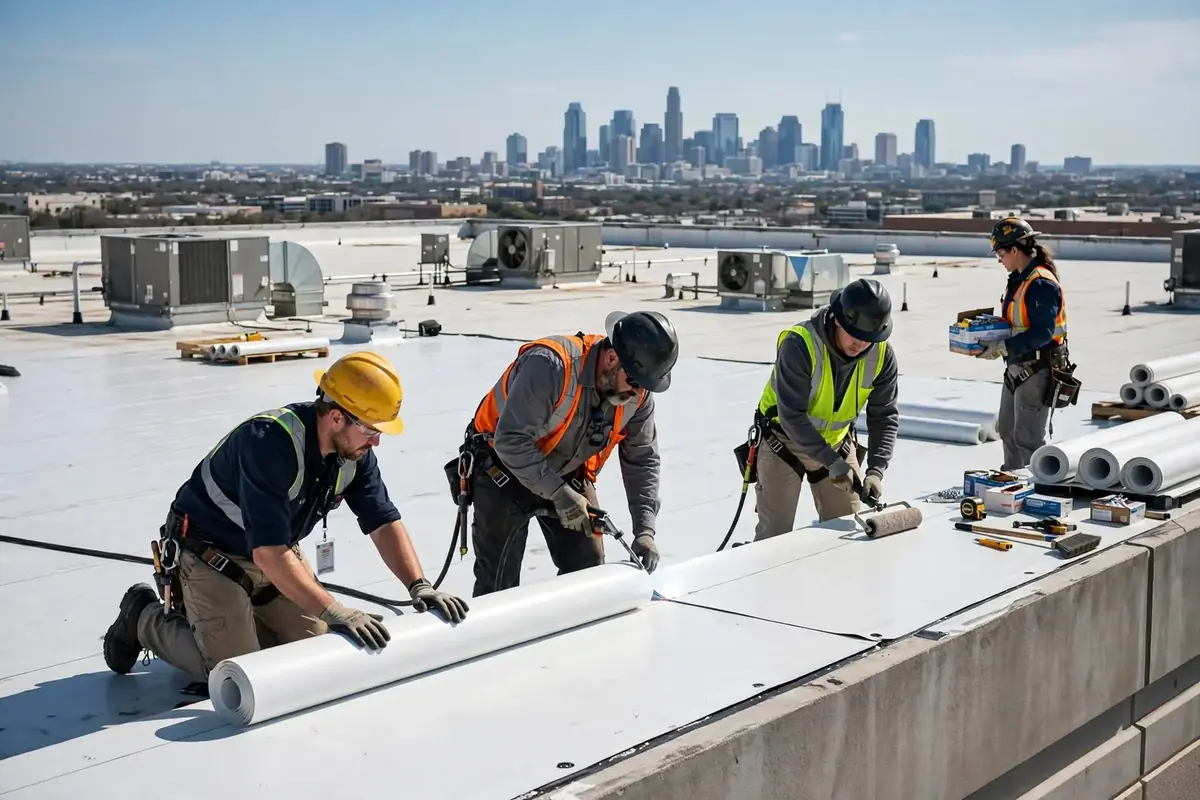
Commercial roofing in Dallas, TX covers the inspection, repair and replacement of roofs on offices, retail units, warehouses and other business premises across Dallas and nearby Dallas County cities. DFW Roofing LLC provides that work for building owners and managers, starting with a free inspection and a written account of the roof's condition so decisions can be based on evidence rather than guesswork.
Commercial roofs are built differently from residential ones. Most are low-slope or flat, with membranes, seams and drains that need regular attention. A small failure over an occupied building can interrupt business, so commercial roofing work is planned around keeping the property protected and operating.
On a commercial building the roof protects more than the structure itself. Stock, equipment, tenant businesses and day-to-day operations all sit underneath it, so a leak that would be an inconvenience in a house can become lost trading time here. That is why we set out the scope, the sequence of work and any access or safety arrangements in writing before a project begins. We are insured and our work is backed by a workmanship warranty.
Signs you may need commercial roofing
Low-slope roofs rarely fail all at once. More often a seam opens, a drain slows or a detail around a rooftop unit weakens, and water finds its way in over time. Watch for:
- Ponding water that stays for days after rain
- Seams lifting, shrinking or splitting on the membrane
- Leaks that show up over inventory, equipment or offices
- Blistering, bubbling or cracking of the roof surface
- Roof drains, scuppers or flashing that are clogged or damaged
- Staining on ceilings or walls below rooftop units, vents and kerbs
- Loose edge metal, damaged pitch pockets or sealant that has pulled away
- A sudden rise in leaks after hail, high winds or work by another trade on the roof
If tenants report dripping, or you can see standing water from an upper window long after rain has stopped, arrange an inspection promptly. Water travelling through a low-slope system can emerge some distance from the entry point, so tracing it accurately matters more than patching the spot where it appears indoors. Call (972) 853-6474 to arrange a free inspection.
What our commercial roofing work includes
The right intervention depends on the system fitted, its age and how much sound material remains underneath. Work can include:
- Inspection and written condition report for the roof
- Repairs to membrane seams, flashing and penetrations
- Roof coating or recover where the system still has life
- Full replacement of low-slope systems when needed
- Drainage review for ponding and clogged drains
- Repairs and replacement on TPO, EPDM and modified bitumen systems, and on metal commercial roofs
- Detail work around rooftop units, vents, kerbs and other penetrations
Low-slope and flat systems explained
TPO is a single-ply membrane with heat-welded seams, widely used on retail and warehouse roofs. EPDM is a rubber membrane, typically joined with tapes and adhesives, so the condition of its seams and edge details deserves close attention as it ages. Modified bitumen is a multi-layer asphalt-based system, often with a granular or coated surface, and it is repaired differently again. Built-up roofing, made from several layers, is still found on older Dallas buildings. Because each system fails in its own way, a repair that suits one can do little good — or cause harm — on another, which is why identification of the existing system comes first in any inspection.
Ponding, seams and drainage
Ponding is the most common complaint on flat roofs here. Water that sits after rain adds weight, works at seams and laps, and finds any weakness around penetrations. It usually points to blocked drains, settled insulation or a fall that no longer takes water where it should go. Seams are the other recurring weak point: they expand, contract and take foot traffic from anyone servicing rooftop equipment. Checking seams, drains and flashing together, rather than treating a leak as a single hole, is what keeps a commercial repair from becoming a recurring call-out.
Minimising disruption to tenants and operations
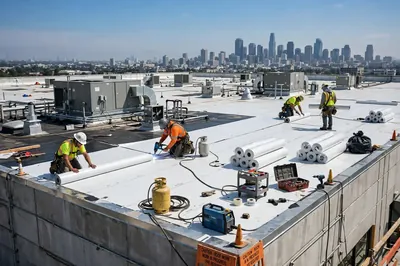
Most commercial buildings cannot simply close while roof work happens. Before a project starts we agree how access will work, which entrances and parking areas stay clear, when noisier work is best scheduled and how the building stays weather-tight at the end of each day. For managers with several tenants, that plan can be shared in advance so businesses below know what to expect. If a roof is actively leaking, tell us where water is appearing and what is underneath it, so protection of stock and equipment can be prioritised from the first visit.
What to know in North Texas
Warehouses, retail strips and offices across Dallas County commonly have TPO, modified bitumen or built-up roofs, and each type is repaired differently. For property managers, a documented inspection record is useful for budgeting, warranty conversations and insurance.
Local weather puts particular pressure on low-slope roofs. Intense summer heat ages membranes and sealants, heavy spring rain tests drains that may already be partly blocked, and hail can dent or puncture a surface in ways that are not obvious from inside the building. Large roof areas also collect wind-blown debris around units and drains, which quietly worsens ponding if it is not cleared. A documented inspection after a major storm, filed alongside your building records, gives you a clear baseline if questions arise later with tenants, insurers or a future buyer.
How it works
- Call or send a requestTell us about the building, the roof system if you know it and where problems are showing.
- Free roof inspectionWe survey the membrane, seams, drains and penetrations and record the condition of the roof.
- Written scope and quoteYou receive the findings, the proposed work and the price, plus a plan for keeping the building operating.
- Work, tidy-up and handoverWe complete the agreed work, leave the site tidy and walk through the finished roof with you.
Why choose DFW Roofing LLC for commercial roofing
On a commercial roof, the work has to fit the building's day as well as its structure. We plan for both:
- Stages, access and noisy work agreed around your opening hours and tenants in advance
- One point of contact throughout, so decisions and updates never get lost
- A written scope and a summary of findings and work done — proper records for facilities and insurance files
- Repairs made with maintenance in mind, catching seams and drainage issues before they reach the rooms below
Commercial Roofing FAQs
What types of commercial roofs do you work on?
Low-slope and flat systems such as TPO, EPDM, modified bitumen and built-up roofing are common here, along with metal roofs on commercial buildings. Tell us about your building and we will confirm what fits.
Can work be done while the business stays open?
Often, yes, with planning around entrances, noise and access. Before work starts we agree working hours, access routes and how the building stays weather-tight each day, so tenants and staff know what to expect. Discuss scheduling and safety before the project begins.
How often should a commercial roof be inspected?
As general industry practice, commercial roofs are usually inspected twice a year, typically in spring and autumn, and again after any major storm. That rhythm catches seam, drainage and storm problems while they are still small repairs. It is general guidance, and the right frequency for your building will depend on its age, system and exposure, which we can advise on after an inspection.
What causes ponding water on a flat roof, and why does it matter?
Ponding usually results from blocked drains, settled insulation or a slope that no longer carries water to the outlets. Standing water adds weight, stresses seams and makes any small weakness more likely to leak, so it should be investigated rather than left. An inspection will show whether clearing, localised repair or drainage correction is the appropriate response.
Can a commercial roof be repaired instead of replaced?
Often it can, provided the membrane and the layers beneath it are still sound and the problem is localised to seams, flashing, penetrations or a defined area of damage. Widespread membrane failure, saturated insulation or repeated leaks across different parts of the roof usually make replacement the more sensible long-term option. We will set out which applies, and why, in the written scope after inspection.
Related roofing services
For a specific problem, these pages cover the detail — from an active leak to a planned replacement.
Where we provide this service
We work throughout Dallas and nearby communities. Choose your city for local details.